

Romans 8: 18-23
Romans 8:18-23
We’re going to stand and read some scripture while the kids are on their way to Junior Church, and this is from Romans chapter 8, verses 18 through 23, and you can follow along on the screen as I read. This is the Apostle Paul writing to the church at Rome. He writes; I consider that our present sufferings are not worth comparing with the glory that will be revealed in us.
He’s saying the best for us is yet to come. For the creation waits in eager expectation for the children of God to be revealed. For the creation was subjected to frustration, not by his own choice, but by the will of the one who subjected it, in hope that the creation itself will be liberated from its bondage to decay and brought into the freedom and glory of the children of God.
We know that the whole creation has been groaning as in the pains of childbirth right up to the present time. Not only so, but we ourselves who have the first fruits of the Spirit groan inwardly as we wait eagerly for our adoption to Sonship, the redemption of our bodies.
All right, very rarely do I steer off of going through a book of the Bible and jump on a topic, but I’ve probably done this maybe three or four times in many years.
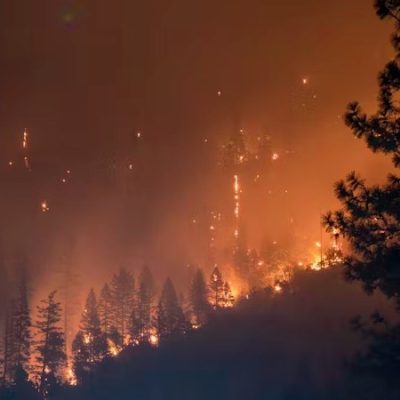
But I thought I would bring a message just relating to a biblical perspective of what’s happening in our world. And we look around and think about what’s happening in the state of California. And you know, that’s all the way over on the other side of the country.
But if you follow the news, it is horrific. And evacuations of 150,000 people, 12,000 homes and schools and churches burned to the ground. And people that wake up one morning and literally have no material possessions.
And we shouldn’t forget what happened in Western North Carolina not that long ago, Hurricane Helene came through and devastated that area and they’re still recovering. And through your gracious giving, we were able to send some funds down to Samaritan’s Purse, which was the boots on the ground to help those people in Western North Carolina. So, we want to think about a biblical perspective of natural disasters because when earthquakes happen, when floods happen, when tsunamis happen, when fires happen, the unspoken question is, well, where’s God in all this? And why is God allowing this to happen? And why doesn’t God do something? And so, we’re going to spend a half hour this morning thinking about this biblical perspective of natural disasters.
And we need to think about what a biblical worldview is. And that’s really looking at the world events through the lens of Scripture, through the framework of what the Bible teaches. And so, we want to think about a biblical worldview.
And we want to think about three biblical truths and then answer the question, well, what should we be doing? Or as the late Dr. Francis Schaeffer wrote in a book a number of years ago back in the 70s, how should we then live? And God, what are you expecting us to do during this time period in our world history? So quickly, we’re going to think about three truths. Here’s the first one. We are living in the in-between.
1. The First Truth
We are living in the in-between. What do I mean by that? Well, I’ll explain it. We’re living in between Genesis 1-2 and Revelation 21 and 22.
We’re living in that time period between the creation of the world when God put Adam and Eve in a place called the Garden of Eden, which was this perfect world, perfect environment. No sin, no sickness. Life was perfect.
That’s Genesis 1-2. That’s the world that God intended. Probably, I don’t know, 30 years ago or now, Diane and I do very little traveling, although in about a week or so, we are going to head down to Florida for a few days.
But about 30, 35 years ago, I would imagine, Diane and I took a trip to Hawaii. And the background of that trip was we had some friends in our previous church, and he was a pilot with what was then Northwest Airlines. And he got transferred out to Hawaii and had a two-year assignment there.
And they said, well, why don’t you come visit us and you can just stay with us? And they had this beautiful home. It was in the middle of this mountain overlooking the ocean. And then also at that time, Diane’s brother was a pilot with American Airlines, and we could fly standby for very little.
So, we thought, let’s go to Hawaii. So, one of the families in our church, previous church, graciously volunteered to watch our three kids. And they all got chicken pox while we were gone.
You know, that was fun for them, or maybe, I don’t know. So, we spent five days in Hawaii. And the reason I’m telling you this story is that everyday Joe, who was our friend, the pilot, would get up and head over, look at the ocean, and say, another day in paradise.
And it kind of was, because every day was just beautiful and sunny. And well, that’s what the Garden of Eden was like. But what happened in Genesis chapter three? We know the story.
Genesis chapter three, sin came into the world and everything changed. Everything changed. What happened? There was a curse, curse on the serpent, Satan.
There was a curse on Eve, pain in childbirth. There was a curse on Adam. It’s going to be pain and toil to work and to earn a living.
And the creation was cursed as well. Ground was cursed. And so now we’re living between Genesis 1 and 2, and what’s going to happen in Revelation 21 and 22? It’s really going to be kind of like Garden of Eden 2.0. There’s going to be a new heaven, and there’s going to be a new earth that God will create.
And this curse that we’ve talked about that is found, and you can read about it in Genesis chapter three, the curse is reversed. Revelation chapter 22 verse three says, no longer will there be any more curse. And so, in the new heaven and the new earth, there’s not going to be any sin.
There’s not going to be any death. There’s not going to be any natural disasters and all these horrific things that happen in our world today. So, all that to say, we are living in the in-between under a cursed world.
And as Paul wrote in Romans 8, what is creation doing? Creation literally is groaning until creation itself will be redeemed, as well as our earthly bodies will be redeemed. So that’s truth number one. We’re living in the in-between.
2. The Second Truth
Second truth is this, natural disasters, like what’s happened in western North Carolina and California, natural disasters remind us of the importance or the priority of the eternal. Natural disasters remind us of the importance or the priority of what is eternal, not temporary. Thousands of people discovered they’ve lost everything materially.
And so, here’s what the apostle Paul says in second Corinthians four, therefore don’t lose heart, don’t be discouraged. Though outwardly we are wasting away, that’s the progression of the body breaking down. And it will, and it does.
Though outwardly we’re wasting away, yet inwardly we can be renewed day by day for our light and momentary troubles. That’s interesting that Paul talks about his light momentary troubles. Oh, you mean the times that you ended up in prison? Oh, you mean the time that you were stoned in Lystra and left for dead? Oh, you mean the time that you were whipped with 39 lashes and shipwrecked and all that kind of stuff? Yeah, light and momentary in comparison to eternity is what he’s talking about.
They’re achieving for us an eternal glory that far outweighs them all. So, here’s Paul’s truth application. So, we fix our eyes not on what is seen, but what is unseen.
Since what is seen is temporary, what is unseen is eternal. Ah, there’s our reminder. The stuff that we accumulate, our homes, our cars, and anything physical material, it’s just what? It’s just, it’s temporary.
And it comes and it goes. And that new shiny car that we’re all excited about when we first get it, eventually is going to wear out, it’s going to rust, it’s going to break down, and it’s going to end up in a scrapyard. And so natural disasters remind us the importance of the eternal.
Jesus asked the question, what does it profit a man if he gains the whole world, has all these material possessions, and loses his own soul? First Timothy 6 don’t put your hope in money, which easily vanishes, but put your hope in God and His promises and His Word. So, what lasts forever? There’s three things on my list, and maybe I’m open to a fourth one, because somebody can think about it. But God is eternal, and God’s Word is eternal.
The grass withers, the flower fades, but the Word of God lasts forever, and the souls of men and women are eternal. We’re all going to live somewhere forever. The question is location, where are we going to be? And so natural disasters remind us, remind us of the importance of the eternal.
3. The Third Truth
Third truth, and then we’ll just think about four quick applications that we can think about how we should then live. It says, natural disasters remind us of the uncertainty of tomorrow or the uncertainty of the future. And those folks in California had no idea that the very next day or the very next week, all that they owned would be gone.
Natural disasters remind us of the uncertainty of tomorrow, and that’s true for us as well. Proverbs 27 verse 1, do not boast about tomorrow, for you do not know what a day may bring forth. We’ve all experienced that, haven’t we? And in one moment, in one phone call, life has changed.
That was true for Ron and Larissa Tindall on Friday afternoon. When they got the phone call, that moms collapsed, mom passes into eternity, and life is turned upside down in one moment. So, James picks up on this theme in James chapter 4 verses 13 through 15, and he’s not forbidding planning.
We all need to plan, but the thrust of this verse is we need to hold our plans very loosely because God’s in control. And so, here’s what James writes, now listen you who say today or tomorrow we will go to this city or that city, spend a year there, carry on business, and make money. So, they’ve got their business plan together for the next year, but then James says, why you do not even know what will happen tomorrow.
You think we know? We all have plans of what the next day and the next week will look like. We really don’t know. You are, what is your life? You are a mist that appears for a little while and then vanishes away? Instead, you ought to say, if it is the Lord’s will, we will live and do this or that.
And so, James doesn’t say that every time we just make a statement we need to say, Lord willing, although there’s nothing wrong with that. James is talking about a mindset that we need to hold our plans loosely because what God is in control. And so natural disasters remind us of the uncertainty of tomorrow.
Now for the believers, here’s our encouragement with the uncertainty of tomorrow is that we believe that God is sovereign over all of life. History is His story, and God’s working out His plan and His story, and that’s true in our individual lives, that nothing happens in our lives that is a surprise to God. Even the horrific things that Job went through, if you hold back the curtain and read Job chapter 1 and chapter 2, that Satan had to have permission from God to touch Job.
And what was Satan’s premise? Of course, Job loves you. You’ve blessed him with ten children. You’ve blessed him with health.
You’ve blessed him with wealth. Of course he’s a follower of you. Just take away some of that and see what happens.
And so, God gave Satan permission to touch Job. He put some parameters on it. And so, God, for the believers, is in control.
And even though tomorrow is uncertain, we can trust Him with our lives. And so, Corrie Ten Boom said, never be afraid to trust an unknown future to a known God. Matthew chapter 6, Jesus says, do not worry, do not worry, do not worry.
He says it four or five times. What’s He tell us to do? Seek first God’s kingdom and all these things will be added unto you. So those are just three quick biblical truths about natural disasters.
What we want to think about this morning is the question that Francis Schaeffer asked, like, well, how should we then live? Romans 13 and 11 says, our salvation is nearer now than when we first believed. He’s talking about the second coming of Christ, the ultimate glorification, the redemption of our bodies. It’s closer than we first believed.
And so, Christ is coming again, but how should we live in the between? And let me give you just four encouragements. They all start with the letter P or have the letter P in them, and then we’ll wrap this up. But here’s the first one.
How should we then live”
How should we then live? Prepare for eternity. Prepare for eternity. Luke chapter 12 is a familiar story that is in the Bible.
And here Jesus got interrupted by someone in the crowd that was following him and said, teacher, tell my brother to divide the inheritance with me. Can you imagine that, that there are some family members that were fighting over inheritance? And so, Jesus gives a warning, be on your guard against all kinds of greed. Life does not consist in the abundance of possessions, what we’ve just talked about.
And then he tells this familiar story about a man that had a plan, and he was a rich man, he had a great harvest, and he says, what shall I do? I have no place to store my crops. I have to tear down my barns and build bigger ones. And I’ll say to myself, you have plenty of grain laid up for many years.
Take life easy, eat, drink, and be merry. I’ve got it all planned out. I’m going to be on easy street.
And Jesus says, one problem, one problem is you’re a fool, because this night your life will be demanded from you. And who will get what you prepared for yourself? This is how we’ll be with whoever stores up things for themselves but is not rich toward God. What does it mean to be rich toward God? He’s talking about receiving salvation.
And so, we spend a lot of time in the finance world and thinking about retirement and retirement planning, but many people do very little thought about what’s beyond that. We have eternity that’s going to last forever. So how do we prepare for eternity? Well, one way is by receiving the gift of salvation and what Christ has done for us on the cross, 1st John 5, 11 through 13, that we can know for sure that we have eternal life, recognizing that we’re a sinner, recognizing we can’t make it to heaven on our own, and putting our trust in Jesus and Jesus alone.
And when he died on the cross, he took our place. It was called the substitutionary atonement. As I like to say, sin has to be paid for.
Either we’re going to pay for it, or we can put our trust in Jesus because he already paid for it. I would suggest that’s a much better option. We need to prepare for eternity.
Between last Sunday afternoon and Friday afternoon, in our circle of friends, some connected here at church, some from previous churches that we’ve ministered in, just our circle of friends, we got six contacts, people that died, of friends of ours who contacted us and said, my loved one has passed away. My father has passed away. My brother has passed away.
Would you pray for us? Our first church was in Strongsville, Ohio. A great family there, the Smallman family. Dr. Smallman was an executive with one of the missions there in Cleveland, Ohio.
And we had his daughter Margie in our youth group that we were working with and had an older brother, David. I was sitting in a restaurant last Saturday afternoon. Diane and I were at Buffalo Wild Wings after going to a wrestling tournament to watch our grandkids wrestle.
And I looked at my phone and I get a message from Margie. My brother went to bed Saturday night, did not wake up Sunday morning. 59 years.
Then he turned. And so, the message this morning is, and there are many other stories this week like that, is that we need to prepare for. Secondly, how should we then live? Understand God’s plan.
Understand God’s plan that as these events happen, as natural disasters happen, and as the world seems to be hurtling out of control, and we read 2nd Timothy 3 that says, in the last days, perilous times will come, difficult times will come. We can have assurance that this isn’t just accidental, that isn’t just randomness, but what God’s got a plan. He’s working out his plan in human history.
And as we study the book of Daniel, as you study the end of the book of Revelation, you can discover what God’s already written in the last chapter. And God has a plan. And God wins.
And we can trust that plan. And even in the difficult new cycles of life, we can have confidence that God has a plan. Thirdly, how should we then live? Not only prepare for eternity and understand God’s plan, but here’s a third thing we can do is we need to pray.
We need to pray. We certainly need to pray for those that are out in California and those that are still struggling in North Carolina and many other places. We need to pray for them.
And if possible, we need to help them in financial ways if we’re able to. But we need to pray. The Bible talks about prayer a lot.
One of the things he says is to pray that the Lord of the harvest will send forth laborers into the mission field. And so, the mission field isn’t just here where we live, but it’s what? Make disciples of all nations. So, Jesus says, would you pray that God would thrust people like Kyle and Tamara Maycroft out in the mission field to share the good news of the gospel with others? Would you pray that God would do that and partner with them? We’re to pray for our leaders.
And tomorrow we’re going to undergo a transfer of leadership in our own country. And we need to pray for President Trump and Vice President Vance. And we need to pray for departing President Biden and Vice President Harris.
Ephesians 6:18 at the armor of God passage, it says, praying always. First Thessalonians 5, pray without ceasing. So, one of the key things that we can do is to pray and to ask God to intervene and work in people’s hearts.
Well, here’s the last one. How should we then live? Not only prepare for eternity and understand God’s plan and pray. Here’s the last one, proselytize.
That’s a P word that just means evangelism. It means to share the good news of the gospel with other people. Imagine that you have a friend that’s in the hospital and dying of cancer.
Imagine that you go and visit them in the hospital, and you have the cure for cancer. You know the cure for cancer. Imagine that you would go to that hospital room, and you would visit them and talk to them about the news, the weather, sports, and then leave.
Never share that you have a cure for his disease. That would be horrible. On one sense, God’s given us what? The good news of the gospel.
And our job is to be faithful people who share the good news of the gospel with other people. And when we think about natural disasters, one of the things that God uses in times of difficulty, tragedy, and loss, guess what happens when that occurs in people’s lives? Their hearts are open and receptive many times to God’s truth and the good news of the gospel. You see, when everything’s going right, when you have your health and your wealth, and the kids are doing well, and your 401k looks good, and all things are set, you kind of feel like, I’m okay.
But when difficulty hits, when loss hits, when tragedy hits, people are searching for something. And we have the answer is Jesus, and our only hope is found in him. So, I’m so thankful that in these times of natural disasters, there’s organizations like Samaritan’s Purse in Boone, North Carolina, Franklin Graham’s head of that ministry, son of Billy Graham.
And they have something called rapid response teams. So, many times there’s a disaster anywhere in the world, but also in the United States, they have this U.S. disaster relief. They put boots on the ground, and they become the hands and the feet and the mouth of Jesus to people who desperately need help.
And they help rebuild, and they provide food, and they provide help to these people in their time of great need. So, I went to their website, and here’s what Samaritan’s Purse says about what’s happening in California. Samaritan’s Purse is poised to quickly mount a response after the California wildfires are contained.
Staff members will be on the ground assessing the hardest hit areas once it is safe to do so. Samaritan’s Purse staff are working with local emergency management personnel to mount a strategic response and will coordinate with local churches throughout the deployment. Volunteer teams will assist homeowners and share the love of Christ as we serve in Jesus’ name.
By the way, there’s a place on their website where you can volunteer to do that. You don’t have to be a pastor. You don’t have to have all this training.
I’m sure they’ll do some training with you. But the disasters that happen, the tragedies that happen are an open door to share the love of Jesus. And I am absolutely positive that out of those California fires, many, many people are going to come to know Jesus who otherwise would not have been open to what we’re talking about.
And so yes, we live in a fallen world. We’re living in the in-between, Genesis 1 and 2, Revelation 21 and 22. Someday there’s a day coming when this curse is going to be reversed and we’re going to enjoy a perfect, perfect world forever and ever in the presence of Christ.
But in the meantime, we need to prepare for eternity. We need to understand God’s plan. We need to be people of prayer.
We need to share the good news of the gospel.